
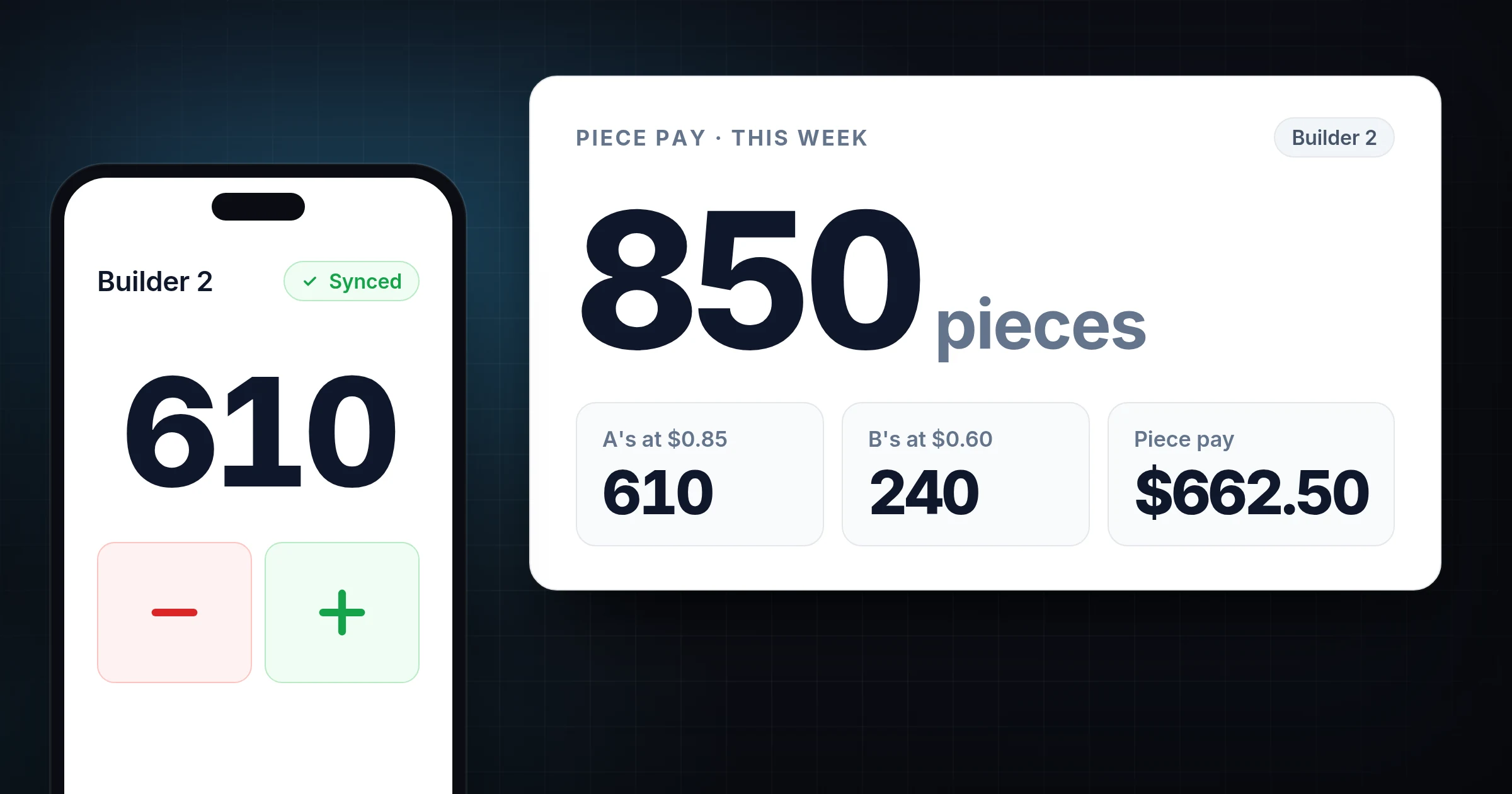
Short answer: piece rate pay is the number of pieces a worker finishes multiplied by the rate per piece. Under the federal Fair Labor Standards Act, a piece rate worker's total pay for the week, divided by all hours worked, must still reach the minimum wage, and for every hour over 40 the worker is owed an extra half of that average hourly rate. Some states, including California, add their own rules. Every one of those numbers starts with an accurate count of each worker's pieces.
This guide walks through how a piece rate system works, the formulas with worked examples, where employers get it wrong, and how to keep a per-worker piece count that holds up on payday. It is a practical explainer, not legal advice: check the rules for your state with the Department of Labor or an employment lawyer before you set rates.
What piece rate pay is
Piece rate pay (also called piecework) pays a worker for output, not time. A pallet builder might earn a set amount per pallet, a sewer per garment, a picker per bin, an assembler per unit. The rate can differ by product or grade: more for a Grade A pallet than for a repair, more for a complex unit than a simple one.
The weekly calculation is simple:
Piece earnings = pieces finished x rate per piece
When there is more than one product or grade, add each line:
| Item | Pieces | Rate per piece | Earnings |
|---|---|---|---|
| Product A | 610 | $0.85 | $518.50 |
| Product B | 240 | $0.60 | $144.00 |
| Week | 850 | $662.50 |
Illustrative rates and counts, not customer data.
The piece rate system: who uses it and why
Piece rate shows up wherever output per person is easy to count and varies a lot between people: pallet yards, agriculture and harvest crews, garment and sewing shops, assembly and packing lines, and some construction and installation trades.
| Pros | Cons |
|---|---|
| Pay tracks output, so fast workers earn more | Workers can rush and quality can slip |
| Easy to explain: count times rate | Pay disputes when the count is unclear |
| Less supervision needed to keep pace | Minimum wage and overtime still apply |
| Rates can reward harder grades or products | Nonproductive time must still be handled correctly |
Most of the cons are counting problems. When everyone trusts the count, piece rate is simple. When the count lives on a paper sheet that someone adds up on Friday, every short week becomes an argument.
Minimum wage under piece rate (federal)
Piece rate does not replace the minimum wage. The federal test is done per workweek: take everything the worker earned that week and divide it by all hours worked. If the result is at or above the minimum wage, the week passes; if not, the employer makes up the difference.
Average hourly rate = total weekly earnings / total hours worked
Example: a worker earns $662.50 in piece pay over 42 hours. $662.50 / 42 = $15.77 an hour, above the federal minimum wage of $7.25. State and local minimums are often higher, and the highest applicable minimum is the one that counts.
Overtime for piece rate workers (federal)
Overtime under the FLSA works differently for piece rate workers than for hourly workers. The rule is in 29 CFR 778.111:
- Add up the week's earnings: piece earnings, plus production bonuses, plus any pay for waiting time or other hours worked.
- Divide by total hours worked to get the regular rate.
- For each hour over 40, add half the regular rate. The piece earnings already paid the straight time for those hours, so only the half-time premium is added.
The regulation's own example: a worker earned $491 at piece rates for 46 productive hours plus $8.00 an hour for 4 hours of waiting time, 50 hours in all.
| Step | Calculation | Result |
|---|---|---|
| Total earnings | $491 + (4 x $8.00) | $523.00 |
| Regular rate | $523.00 / 50 hours | $10.46 |
| Overtime premium | 10 hours x ($10.46 / 2) | $52.30 |
| Total for the week | $523.00 + $52.30 | $575.30 |
The regulation also describes an alternative method, at 29 CFR 778.418, where overtime is paid at one and a half times the piece rate for pieces made during overtime hours. It needs an agreement in advance; check the rule before using it.
California and other state rules
Some states go further than federal law. California's Labor Code section 226.2 requires piece rate employers to:
- Pay rest and recovery periods separately from piece pay, at the higher of the worker's average hourly rate for the week or the applicable minimum wage.
- Pay other nonproductive time separately, at no less than the applicable minimum wage. Nonproductive time is time under the employer's control that is not spent on the piece rate work, such as waiting for materials or required meetings.
- Show those hours, rates, and wages separately on the pay stub.
That means a California employer needs both a per-worker piece count and a record of rest and nonproductive time. Other states have their own rules; check your state labor department before setting up a piece rate plan.
Where piece rate pay goes wrong
- The count is unclear. A tally sheet with smudged marks, a stack counted as one piece, or a sheet that went missing. Pay can only be as accurate as the count underneath it.
- Grades or products are mixed. If two products pay different rates, they need separate counts per worker, not one total.
- Hours are not tracked. Without hours, there is no way to run the minimum wage test or work out the regular rate for overtime.
- Waiting time is ignored. Time spent waiting for materials or a machine is hours worked, and it goes into the calculation.
- Workers only see their count on payday. Disputes are cheaper to settle on Tuesday, while the stack is still in the yard, than on Friday.
How to keep a per-worker piece count you can trust
The piece count has two jobs: it is the pay record, and during the shift it shows each worker where they stand. A live shared count does both on the phones your team already has:
- A group for each worker, with a counter for each product or grade that pays a different rate. Use the same counter names in every group.
- Each piece goes in with a tap as it is finished, on the worker's own phone or a shared phone at the station. On Pro, one tap can add a full bundle or case.
- Each worker sees their own count live, so a short day shows up during the shift, not on payday.
- The Totals tab adds each product up across every worker, and you can open a product to see each worker's share.
- On Pro, each day's count per worker and per item exports as CSV or JSON for whoever runs pay, or is emailed to the office on a schedule. Enterprise adds every tap as its own row with its exact time.
From there, the export goes into your payroll spreadsheet or system, where the rates, hours, minimum wage test, and overtime are applied.
The free guest count starts with one counter per worker; rename them, then save it into an account to keep each day. See how a whole floor runs on it on production counts per worker, or how a pallet yard counts each builder's stacks by grade on pallet yards. For what the grades on a yard's sheet mean, see pallet grades explained.
Evidence and limitations
The federal rules above summarize 29 CFR 778.111 and the FLSA's workweek minimum wage test; the California rules summarize Labor Code section 226.2. Rates, counts, and the product example are illustrative. Laws change and vary by state and city, so confirm the rules that apply to you with the Department of Labor, your state labor agency, or an employment lawyer.
SnapCount counts by manual taps only and is not a payroll or timekeeping system. It records each worker's count by day; it does not track hours, calculate pay, or apply minimum wage or overtime rules.
Updated October 12, 2026.
Frequently asked questions
How do you calculate piece rate pay?
Multiply the number of pieces each worker finished by the rate per piece, and add up each product or grade that pays a different rate. Then check that the week's total, divided by all hours worked, reaches the applicable minimum wage, and add overtime for hours over 40.
Is piece rate pay legal?
Yes, in the United States piece rate pay is legal as long as the worker's total weekly pay, divided by all hours worked, meets the applicable minimum wage, and overtime is paid for hours over 40. Some states, such as California, add rules for rest and nonproductive time.
How is overtime calculated for piece rate workers?
Under federal rules, divide the week's total earnings, including bonuses and pay for waiting time, by all hours worked to get the regular rate. For each hour over 40, the worker is owed an extra half of that regular rate.
Do piece rate workers get paid for breaks?
Under federal law, short breaks count as hours worked and are covered by the weekly minimum wage test. California requires rest and recovery periods to be paid separately from piece pay, at no less than the worker's average hourly rate for the week or the minimum wage, whichever is higher.
What is an example of piece rate pay?
A pallet builder paid $0.85 per Grade A pallet and $0.60 per Grade B pallet who builds 610 A's and 240 B's in a week earns $518.50 plus $144.00, or $662.50, before the minimum wage and overtime checks. These figures are illustrative.
How do you track piece counts per worker?
Give each worker their own count with a counter for each product or grade, and record each piece as it is finished. A shared live count on phones shows each worker their own number during the shift and keeps each day's count per worker for payroll.
Topics: piece rate pay, piece rate system, piecework, production count per worker, overtime
About SnapCount Team
The SnapCount Team builds and tests shared counting workflows for events, inventory, attendance, and field work. We review these articles when product workflows change and link to the tools we use to validate them.
Contact SnapCount support