
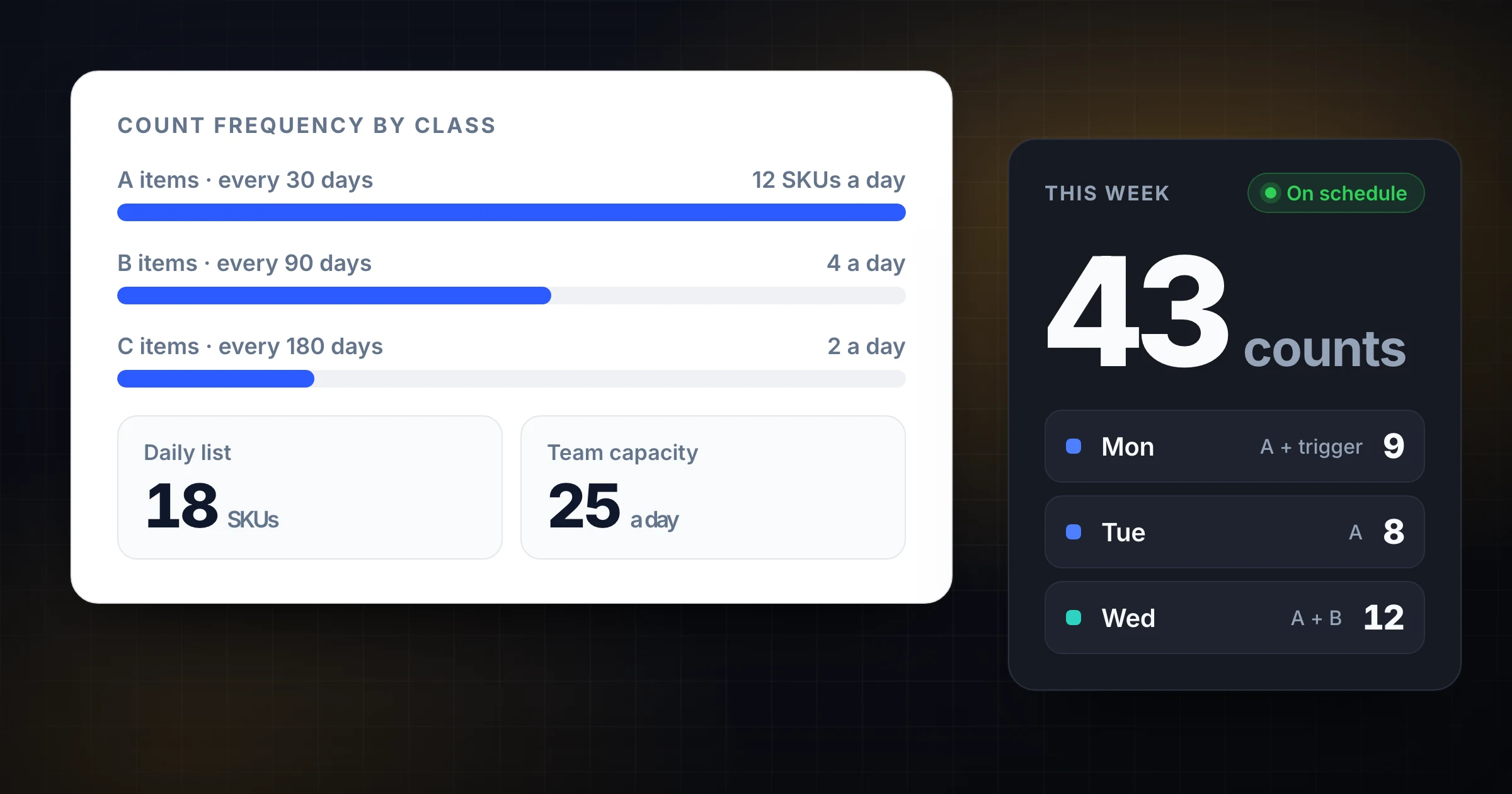
Cycle count frequency is how often each SKU, bin, or location gets counted as part of your inventory accuracy program. The right answer is rarely "count everything monthly." That sounds clean in a meeting, but it usually collapses on the warehouse floor.
The better answer is to count the inventory that can hurt you most, most often. A fast-moving $400 component should not have the same schedule as a slow-moving box of labels. A bin that has produced 6 variances this quarter should not wait for the same annual count as a stable C item.
This guide gives you a practical way to set cycle count frequency by item class, risk, and warehouse capacity. If you are still building the full process, read the cycle counting best practices playbook first, then use this schedule to turn the program into daily work.
Start with the job frequency is supposed to do
Cycle count frequency is not a compliance checkbox. It is a control system.
Your schedule should help you answer 4 questions:
- Which items are most likely to create costly errors?
- Which areas of the warehouse drift out of accuracy fastest?
- How quickly do you need to discover a variance?
- How much counting can your team finish without rushing?
If a SKU ships every day, a wrong quantity can create backorders this week. If a SKU moves twice a year, a wrong quantity may not matter for months. If a location is constantly touched by receiving, picking, returns, and replenishment, it needs a tighter schedule than a reserve shelf with sealed cases.
That is why strong cycle count programs use different frequencies for different inventory. Frequency should follow operational risk, not spreadsheet neatness.
The standard ABC cycle count frequency
ABC analysis is the most common starting point because it ties counting effort to business impact. You classify inventory into A, B, and C groups based on value, velocity, margin impact, pick frequency, or a blend of those factors.
The standard schedule looks like this:
| Item class | Share of SKUs | Typical business impact | Practical count frequency |
|---|---|---|---|
| A items | 10% to 20% | Highest value, fastest movers, or order-critical SKUs | Every 30 days |
| B items | 20% to 30% | Moderate value or moderate movement | Every 60 to 90 days |
| C items | 50% to 70% | Low value, slow movers, low service risk | Every 180 to 365 days |
This is a starting point, not a law. A warehouse with very high-value medical parts may count A items weekly. A small stockroom with stable demand may count A items every 60 days. The key is that A items get more attention than B items, and B items get more attention than C items.
If you have not classified your inventory yet, use the ABC analysis cycle counting guide before you set the calendar. Without classification, frequency becomes guesswork.
Daily cycle counts keep the habit alive
Most warehouses should count daily, even if the daily list is small.
Daily does not mean every SKU gets counted every day. It means the warehouse performs a defined cycle count task every working day. That habit matters more than most teams expect.
A daily count rhythm gives you:
- Faster variance discovery.
- Less disruption than large weekly count batches.
- A clear owner for each day's work.
- More recent evidence when you investigate root causes.
- A steady accuracy trend instead of a monthly surprise.
The schedule can be light. A small warehouse might count 20 SKU-location pairs each morning. A mid-size warehouse might count 60. A larger operation might split 150 counts across zones and shifts.
The important rule is completion. If the team can finish 50 clean counts per day, schedule 40 until the routine is stable. A finished daily list creates trust. A half-finished list creates ambiguity.
Weekly counts work for smaller stockrooms
Weekly cycle counting can work when inventory is small, stable, and owned by one or two people.
For example, a repair shop with 600 parts may not need a daily count. Counting every Tuesday morning could be enough if the same team receives, stores, and issues parts carefully. A retailer with one backroom and low SKU turnover might also use a weekly list.
Weekly schedules usually fail in larger warehouses for 3 reasons.
First, the batch gets too big. A team that could finish 25 counts per day may struggle to finish 125 on Friday, especially when the shift is already busy.
Second, investigation gets stale. If a variance happened on Monday and the count happens Friday, the receiving error, pick short, or transfer mistake is harder to reconstruct.
Third, skipped weeks hurt more. Missing one daily list is recoverable. Missing one weekly list can wipe out a meaningful chunk of the schedule.
Use weekly counts only when the count load is genuinely small and the inventory risk is low. If errors affect order fill rate, cash, audit confidence, or customer commitments, move to a daily rhythm.
Monthly counts are reports, not controls
Monthly cycle counting sounds organized, but it is usually too slow for active inventory.
A monthly count may be fine for low-risk C items, spare fixtures, seasonal supplies, or storage locations that rarely move. It is not a good control for high-value items, fast movers, or inventory that changes hands several times per week.
The problem is the delay. If a receiving team has been miscounting cases since the first week of the month, a month-end count finds the variance after the bad process has already repeated many times. You adjust the number, but the damage is already in the system.
Monthly counts are better as summary checkpoints:
- Review inventory accuracy by class.
- Check whether daily lists were completed.
- Compare dollar variance by week.
- Reset the next month's A, B, and C count calendar.
- Identify repeat variance SKUs for extra attention.
In other words, count continuously and review monthly. Do not wait until month end to discover avoidable errors.
Add trigger-based counts for problem signals
ABC frequency handles the planned schedule. Trigger-based counts handle warning signs.
A trigger-based count happens because something in the operation says, "Check this now." It should not wait for the next scheduled count date.
Common triggers include:
| Trigger | Why it matters | Count timing |
|---|---|---|
| Negative inventory balance | The system allowed demand to exceed recorded stock | Same day |
| Pick short | A picker could not find expected stock | Before the next wave if possible |
| Zero balance after a pick | Confirms the bin is truly empty | Same shift |
| Receiving variance | Supplier carton, pallet, or unit count does not match | Before putaway closes |
| Repeated customer backorder | Stock record may be unreliable | Same day |
| High-dollar adjustment | Material financial impact | Before approval |
| Bin relabeling or relocation | Location data can drift | During the move |
Trigger counts are especially useful because they catch errors close to the moment they appear. They also teach you where the process is breaking. If one vendor creates repeated receiving variance triggers, you have a supplier or receiving control problem. If one zone creates repeated pick shorts, you may have a location accuracy or replenishment problem.
The U.S. Government Accountability Office's guide on consistent, accurate physical counts of inventory emphasizes documented procedures, supervision, and follow-up. Trigger counts support that principle because they force immediate follow-up when the inventory record shows risk.
Use this formula to check capacity
The best schedule is the one your team can actually finish.
Use this simple capacity check:
| Input | Example |
|---|---|
| Total A items | 600 |
| A-item count frequency | Every 30 working days |
| Total B items | 1,200 |
| B-item count frequency | Every 90 working days |
| Total C items | 2,200 |
| C-item count frequency | Every 250 working days |
Daily count load:
| Class | Math | Counts per working day |
|---|---|---|
| A | 600 / 30 | 20 |
| B | 1,200 / 90 | 14 |
| C | 2,200 / 250 | 9 |
| Total scheduled load | 20 + 14 + 9 | 43 |
Then add a buffer for trigger-based counts and recounts. If you expect 10 extra counts per day, the real daily workload is about 53.
Now compare that with actual counter capacity. If one trained counter finishes 35 clean SKU-location counts per hour and you can spare 90 minutes per day, you have about 52 counts of capacity. That schedule is tight but possible. If your team can spare only 45 minutes, the schedule will fail unless you reduce frequency, reduce scope, or add help.
Do this math before announcing the program. A schedule that looks perfect in a spreadsheet is useless if the warehouse cannot finish it.
Change frequency when risk changes
Cycle count frequency should not be frozen for the year.
Increase frequency when:
- A SKU has repeated variances.
- Demand spikes during a season or promotion.
- A vendor changes pack size, carton quantity, or labeling.
- A location becomes a high-touch forward-pick bin.
- A product becomes critical to customer orders.
- A new team or shift starts handling the item.
Decrease frequency when:
- A SKU has shown stable accuracy for several cycles.
- Movement slows or the item becomes obsolete.
- The item moves from A or B class into C class.
- The cost of counting clearly exceeds the risk of error.
Do not change the schedule every week. Review frequency monthly or quarterly. The point is to let the schedule learn from the operation without creating constant churn for counters.
A practical 90-day rollout plan
If you are starting from annual physical inventory, do not try to build the perfect cycle count calendar on day one. Roll it out in phases.
Days 1 to 15: prove the daily habit
Pick a small list of high-impact items. Count 15 to 30 SKU-location pairs per day. Track completion rate, variances, root causes, and time spent counting.
The goal is not full coverage yet. The goal is to prove the team can count every day without disrupting shipping, receiving, or replenishment.
Days 16 to 45: add ABC frequency
Classify inventory into A, B, and C groups. Start with a conservative schedule, such as A items every 45 days, B items every 120 days, and C items once a year.
Keep the daily list small enough to finish. If completion stays above 95 percent, increase coverage.
Days 46 to 90: tighten the high-risk items
Move the highest-risk A items to a 30-day or weekly schedule. Add trigger-based counts for pick shorts, negative balances, receiving variances, and high-dollar adjustments.
By day 90, you should have a working baseline: daily counts, ABC coverage, trigger rules, and a weekly review of variance causes. From there, adjust frequency based on evidence, not preference.
The decision checklist
Use this checklist when deciding how often to count a SKU or location.
| Question | If yes, count more often |
|---|---|
| Does a wrong quantity create backorders or missed shipments? | Yes |
| Is the SKU high value or high margin? | Yes |
| Does the item move daily or weekly? | Yes |
| Has the SKU had repeat variances in the last 90 days? | Yes |
| Is the location touched by several teams or shifts? | Yes |
| Is the item new, seasonal, promoted, or vendor-sensitive? | Yes |
| Would an adjustment require supervisor or finance approval? | Yes |
If none of those are true, the item probably belongs on a slower C-item schedule. If several are true, it belongs on a tighter A-item or problem-SKU schedule, even if its dollar value is not huge.
The schedule that works for most warehouses
Most warehouses can start with this:
| Inventory type | Frequency |
|---|---|
| A items | Every 30 days |
| B items | Every 90 days |
| C items | Once or twice per year |
| Repeat variance SKUs | Weekly until stable |
| Pick shorts and negative balances | Same day |
| Receiving variances | Same day, before final putaway |
| Problem zones | Weekly location count |
That schedule is simple enough to run and strong enough to catch the errors that matter. It also leaves room for judgment. If your A-item list is too large, tighten the top 100 first. If C items are consuming too much effort, slow them down and use that time on trigger counts.
Cycle count frequency is not about counting as much as possible. It is about counting early enough to prevent bad inventory data from turning into bad warehouse decisions.
Frequently asked questions
How often should cycle counts be performed?
Most warehouses should perform cycle counts daily, with different SKUs rotating through the schedule. A common starting point is A items every 30 days, B items every 60 to 90 days, and C items once or twice per year.
Should cycle counting be daily or weekly?
Daily cycle counting is better for active warehouses because the work is smaller, easier to finish, and closer to the root cause of errors. Weekly counting can work for small stockrooms with low movement and one clear owner.
How often should A items be cycle counted?
Count A items at least monthly in most warehouses. Count them weekly if they are high value, fast moving, repeatedly inaccurate, or critical to customer orders.
Can cycle counting replace annual inventory?
Cycle counting can replace annual physical inventory when the program covers every SKU, documents variance investigation, maintains reliable accuracy metrics, and satisfies your auditor's requirements. Confirm the change with your finance team or auditor before ending annual counts.
What is the best cycle count schedule for a small warehouse?
Start with 15 to 30 counts per working day, focused on the highest-value and fastest-moving items. Once the team completes the list consistently, expand to A, B, and C coverage with slower counts for low-risk inventory.
Topics: cycle count frequency, cycle counting, inventory accuracy, warehouse operations
About SnapCount Team
The SnapCount Team builds and tests shared counting workflows for events, inventory, attendance, and field work. We review these articles when product workflows change and link to the tools we use to validate them.
Contact SnapCount support