
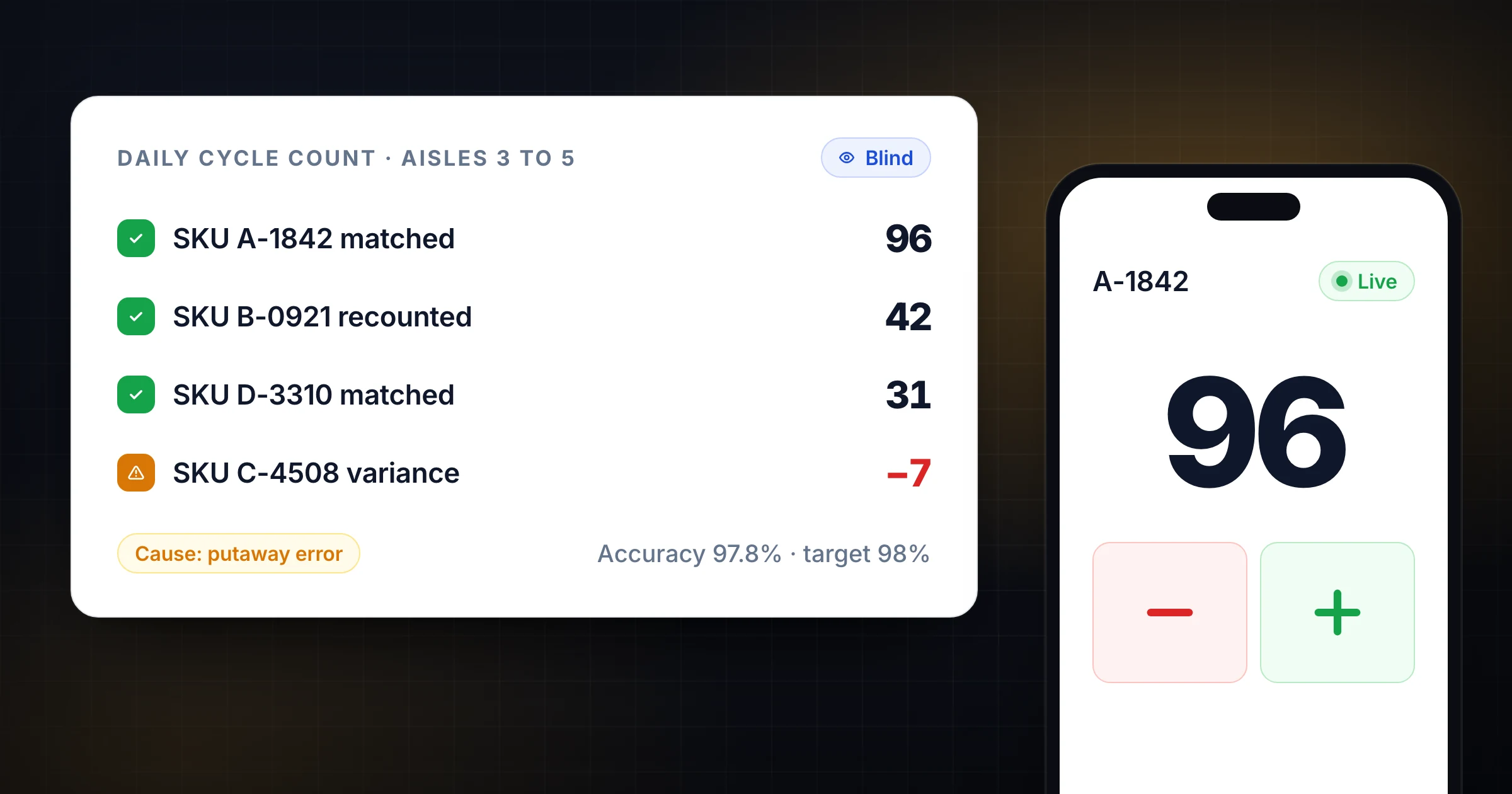
Cycle counting fails when it becomes a small version of the annual physical count: a list of SKUs, a rushed walk through the aisles, and a batch of adjustments at the end. The count is done, but nothing gets more accurate.
The best cycle counting programs work differently. They are built around a daily rhythm, clear ownership, blind counts, fast variance review, and a short feedback loop back to receiving, picking, and putaway.
This playbook is for warehouse managers who already know the basics and want the operating system. If you are still deciding whether cycle counting is the right approach, start with our plain-English guide to what cycle counting means. If you are ready to run counts with multiple people on the floor, see how SnapCount supports warehouse cycle counts and stocktakes.
Start with one count owner
Cycle counting needs one directly accountable owner. Not five people who all "help with inventory." One person owns the calendar, the daily list, the variance log, and the weekly review.
That person does not have to count every SKU. In a growing warehouse, they usually should not. Their job is to make sure the process happens the same way every day:
- Today's count list is ready before the first shift starts.
- Counters know which aisles, bins, or SKUs they own.
- Counts are recorded before the end of the shift.
- Variances are reviewed while the day is still fresh.
- Root causes are assigned, not left as vague inventory noise.
Without this owner, cycle counting becomes optional work. It gets skipped when receiving is heavy, when a supervisor is out, or when the team is short-staffed. That is exactly when bad inventory data starts spreading.
Choose the right count method for each SKU
Most warehouses do not need one cycle counting method. They need a simple blend.
ABC analysis should carry the main schedule. Your highest-value, highest-velocity, and highest-risk SKUs deserve the most frequent counts. Random sampling gives you a cleaner picture of overall inventory accuracy. Triggered counts catch problems when the system is already warning you that something is wrong.
| Count method | Best for | Typical cadence | Watch-out |
|---|---|---|---|
| ABC cycle counting | High-value and high-velocity SKUs | A items monthly, B items quarterly, C items annually | Do not let C items disappear from the calendar |
| Random sample counts | Audit confidence and broad accuracy checks | Weekly or monthly sample | Random does not mean careless. Use a documented sample method |
| Triggered counts | Zero balances, negative stock, receiving variances, pick shorts | Same day as the trigger | Treat it as a process alarm, not just an adjustment task |
| Location counts | Messy aisles, forward-pick zones, quarantine areas | Weekly for problem zones | Count by bin and location, not just by SKU |
For a first program, start with ABC plus triggered counts. That gives you a predictable daily rhythm and catches the worst operational problems before they wait for the next scheduled count.
Keep the daily list small enough to finish
A cycle count list that gets half-finished is worse than a smaller list that gets finished every day. The unfinished list creates ambiguity. Did the team skip the last 20 SKUs because the aisle was blocked, because the items were missing, or because nobody owned them?
Set the daily list based on real capacity. Watch two trained counters for a week and measure how many clean counts they complete per hour. Include walking time, relabeling confusion, recounts, and variance notes. Then set the target below that number.
A useful starting range:
- Small warehouse: 15 to 30 SKU-location counts per day.
- Mid-size warehouse: 40 to 80 counts per day.
- Larger operation: 100+ counts per day, split by zone or shift.
The number itself matters less than the finish rate. If you complete 95 percent of scheduled counts every day, you can increase the load. If you finish 60 percent, cut the list and rebuild trust in the routine.
Count blind whenever the variance matters
Blind counting means the counter does not see the expected system quantity before recording the physical count. It is one of the highest-impact cycle counting best practices because it removes anchor bias.
If the system says 96, a tired counter sees 92 and is tempted to look again until 96 appears. If the system quantity is hidden, the counter records what is actually on the shelf. That is the whole point.
Use blind counts for:
- A items and high-dollar SKUs.
- Items with repeated variances.
- Audit sample counts.
- Any count where an adjustment would cross an approval threshold.
You do not need blind counting for every low-value, low-risk SKU. For C items, a visible expected quantity can be acceptable if the goal is speed and the adjustment risk is small. But for the inventory that affects revenue, margin, or customer orders, hide the book quantity until after the first count is submitted.
Separate counting from reconciliation
The person counting should not be the same person deciding the final adjustment. This is not about mistrust. It is about preserving the quality of the data.
Use a two-step workflow:
- The counter records the physical quantity and notes obvious issues.
- The count owner or supervisor reviews any variance, checks recent transactions, and decides whether to recount, investigate, or adjust.
This separation prevents a common failure mode. A counter finds 18 units where the system says 21, assumes 3 must be missing, and changes the record. Later you discover a pick ticket was staged but not posted, or 3 units were sitting in quality hold. The count was accurate, but the adjustment was wrong.
Reconciliation should check at least four places before an adjustment:
- Open picks or unposted shipments.
- Recent receipts and putaway records.
- Returns, damage, quality hold, or quarantine locations.
- Alternate bins where the SKU may have been moved without a clean transaction.
If you cannot explain the variance, you can still adjust when the business requires it. But label the cause as unknown and review unknown causes weekly. Too many unknowns means the process is not learning.
Investigate root causes, not just variances
A variance is the symptom. The root cause is the operational problem that created it.
Use a short, consistent cause list. Do not let the variance log become a free-text swamp. Start with these categories:
- Receiving error.
- Putaway error.
- Pick error.
- Unit-of-measure confusion.
- Damage or scrap not posted.
- Return not processed.
- Transfer not posted.
- Theft or loss.
- Previous count error.
- Unknown.
The category is not there for reporting theater. It tells you where to fix the warehouse. If pick errors account for 40 percent of A-item variances, you do not need more counting. You need better pick confirmation. If unit-of-measure confusion appears every week, fix the SKU master, labels, and pack-size training.
The U.S. Government Accountability Office's guide on consistent, accurate physical counts of inventory is old, but the principle still holds: strong inventory counts depend on planning, documented procedures, supervision, and follow-up. Cycle counting gives you more chances to apply those controls because you are doing the work continuously, not once a year.
Use accuracy targets by class
One warehouse-wide accuracy target hides too much. A 94 percent average sounds fine until you learn that A items are at 88 percent and C items are at 98 percent. The cheap slow movers are making the number look better than the operation really is.
Set targets by class:
| Item class | Practical target | What it means |
|---|---|---|
| A items | 97% to 99% | The SKUs that drive value and order fill rate should rarely be wrong |
| B items | 94% to 97% | Moderate-value items need steady control without consuming all count time |
| C items | 90% to 95% | Lower-value items still matter, but they do not deserve the same daily attention |
| Problem SKUs | Measured separately | Repeated variance items should not be averaged away |
Track both line accuracy and dollar accuracy. Line accuracy asks, "How many SKU-location counts matched?" Dollar accuracy asks, "How much value was off?" You need both. A warehouse can have a high line accuracy rate and still carry a painful dollar variance if the misses are concentrated in expensive items.
Count by location, report by SKU
Counters should move through the warehouse in a physical path. Supervisors should review results by SKU, value, and cause.
That distinction saves time. If today's list includes 50 A items scattered across the building, sort the count route by aisle, bay, shelf, and bin. The counter should not walk from Aisle 1 to Aisle 11 and back to Aisle 2 because a spreadsheet sorted alphabetically.
After the count, report the results in a way that helps decisions:
- Top variances by dollar value.
- Repeat variance SKUs.
- Accuracy by item class.
- Accuracy by zone or aisle.
- Root causes by count week.
This is where a simple counting app beats a loose spreadsheet. With SnapCount, multiple staff can count separate zones at the same time while a manager watches the totals come in live. If you need a starting structure, use the warehouse stocktake template and adapt it to your SKU classes.
Lock the counted location during the count
Cycle counts become unreliable when normal movement keeps happening inside the counted location. A picker removes 6 units while the counter is checking the bin. Receiving puts 12 units away before the supervisor reconciles the variance. The system changes, the shelf changes, and nobody knows which number is true.
You do not have to freeze the whole warehouse. Lock the specific location or SKU long enough to count and reconcile it.
Common approaches:
- Count before picking starts.
- Temporarily mark the bin as under count.
- Route urgent picks through the count owner.
- Count after replenishment but before the next wave.
- Record any movement that happens during the count window.
The policy can be simple. What matters is that the team knows when a count is protected and who can override it.
Review the program every Friday
Daily cycle counting creates data. Weekly review turns that data into operational control.
Put 30 minutes on the calendar every Friday. The count owner, warehouse supervisor, receiving lead, and picking lead should look at the same small scorecard:
- Count completion rate.
- A, B, and C item accuracy.
- Total dollar variance.
- Top 10 variance SKUs.
- Root causes by count.
- Unknown-cause percentage.
- Open corrective actions.
Do not turn this into a long meeting. The goal is to decide what changes next week. Maybe receiving needs a carton-count check on one vendor. Maybe a zone needs relabeling. Maybe the daily list is too large and the team is rushing the last hour.
The weekly review is where cycle counting becomes more than an inventory correction process. It becomes a warehouse improvement loop.
Frequently asked questions
What is the most important cycle counting best practice?
Finish the daily list and investigate every meaningful variance. A smaller complete program beats a large inconsistent program because it creates a dependable rhythm and trustworthy trend data.
Should cycle counts be blind?
Yes, for high-value SKUs, repeated variance items, and audit samples. Blind counts prevent counters from unconsciously matching the system quantity instead of recording what is physically present.
How many SKUs should a warehouse cycle count per day?
Start with the number your counters can finish at a clean pace. Many small warehouses begin with 15 to 30 SKU-location counts per day, while mid-size teams often handle 40 to 80.
Who should approve cycle count adjustments?
A supervisor, inventory control lead, or count owner should approve material adjustments. Counters can record physical quantities, but reconciliation should check open transactions, alternate locations, and likely root causes before the inventory record changes.
How do you know if cycle counting is working?
You should see fewer repeat variances, lower dollar variance on A items, a shrinking unknown-cause percentage, and fewer order delays caused by stock surprises. The metric is not how many counts you perform. The metric is whether inventory gets more reliable.
Topics: cycle counting, warehouse management, inventory accuracy, stock control
About SnapCount Team
The SnapCount Team builds and tests shared counting workflows for events, inventory, attendance, and field work. We review these articles when product workflows change and link to the tools we use to validate them.
Contact SnapCount support