
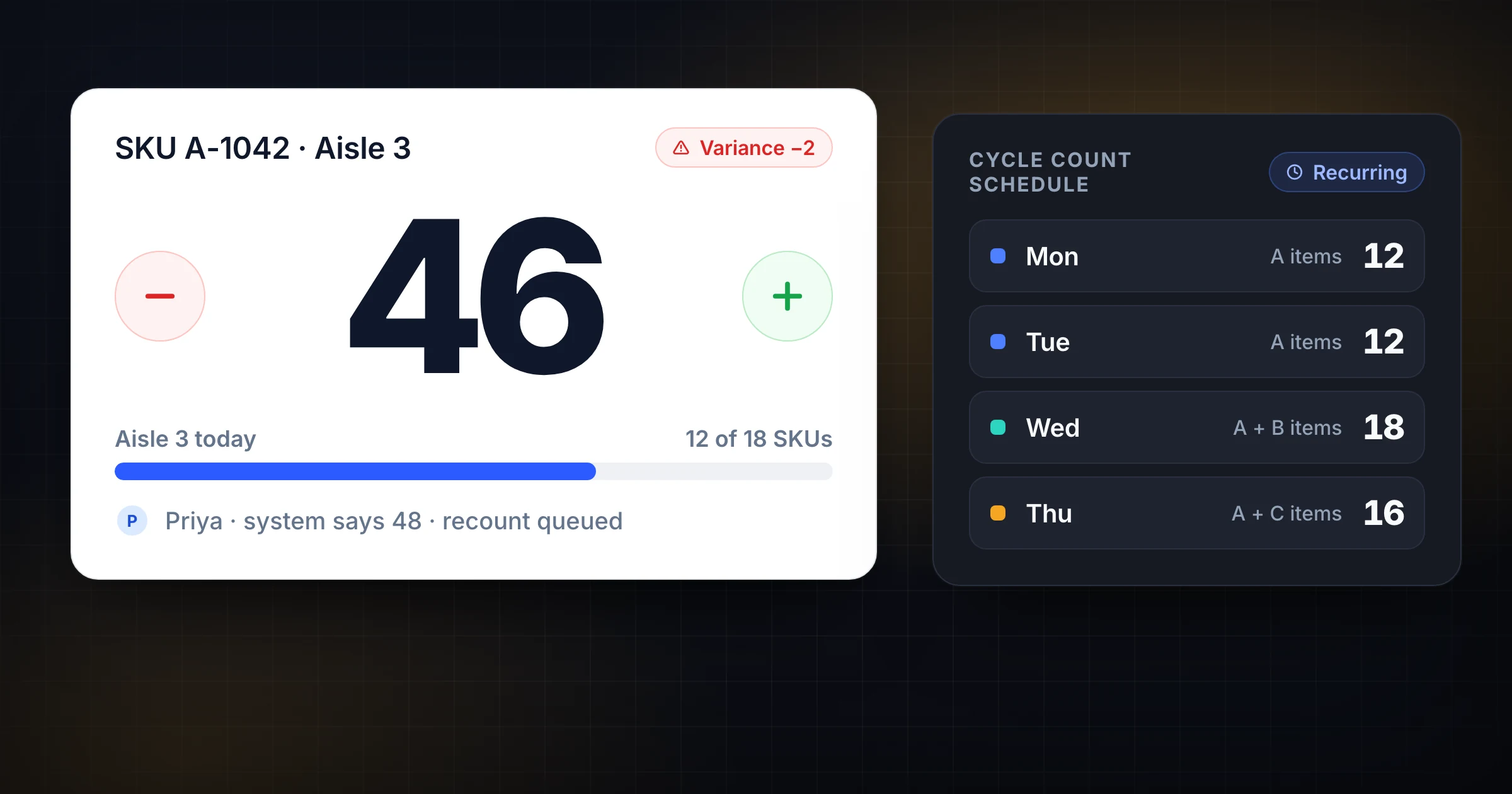
Cycle counting is a recurring inventory audit where a warehouse counts a small, scheduled set of SKUs or locations instead of shutting down operations for one annual physical inventory.
The goal is simple: keep inventory records accurate throughout the year. A team counts selected items, compares the physical count to the system quantity, investigates discrepancies, adjusts the record, and uses the findings to fix the process that caused the mismatch.
If your warehouse still shuts down for two days every January so the whole team can count every SKU on the floor, you already know the problem. The numbers come out wrong, the count itself disrupts shipping, and you find out about your accuracy problems exactly once a year, long after you can do anything about them.
Cycle counting is the fix. It is the practice of counting a small portion of your inventory every working day, on a rotating schedule, so you never have to do a full physical count again and you find out about discrepancies the same week they happen.
This guide walks through what cycle counting actually is, how it works in practice, the three most common methods, how often to do it, and what to watch out for. It is written for warehouse managers, ops leads, and inventory analysts who want a clear playbook, not academic theory.
If the process is already clear but the floor workflow is getting messy, read the inventory counter app guide for when to move shared counts out of spreadsheets. If you are deciding cadence, use the cycle count frequency guide; if you still need a one-time baseline, use the stocktake checklist first.
Cycle counting definition
Cycle counting is a perpetual inventory audit process where a small, scheduled set of SKUs or locations is counted repeatedly throughout the year, discrepancies are investigated, and inventory records are corrected without shutting down warehouse operations.
What cycle counting actually means
Cycle counting is a continuous inventory audit method. Instead of stopping operations once a year to count everything, you count a few items every day on a planned rotation. Over a full cycle (a quarter, a year, whatever you choose), every SKU gets counted at least once. Higher-value or higher-velocity items get counted more often.
The defining traits:
- The warehouse keeps running. Cycle counts happen alongside picking, receiving, and putaway.
- Counts are small and scheduled. A typical cycle count covers 10 to 100 SKUs in a single session.
- Discrepancies get investigated and corrected immediately, while the cause is still traceable.
- Accuracy is tracked as a rolling metric, not a once-a-year snapshot.
The accounting goal is the same as a physical inventory: your system numbers should match what is actually on the shelf. The operational difference is huge. With cycle counting, you find the four missing pallets of Item A on Tuesday and figure out which receiving error caused it on Wednesday. With a once-a-year count, you find them in January and have no idea when they went missing.
Why inventory accuracy matters
Inventory record inaccuracy is not just a bookkeeping nuisance. Academic work on inventory record inaccuracy has found that auditing practices can reduce the gap between system quantities and physical inventory, while operational complexity can make that gap worse. A distribution-center study on cycle counting also grouped inventory count accuracy into bands starting below 90 percent and extending above 99 percent, which matches how many operations teams think about accuracy maturity.
For warehouse managers, the practical impact is simple:
- Bad records create stockouts even when product is physically present.
- Pickers waste time looking for inventory in the wrong location.
- Purchasing teams reorder too early or too late.
- Annual physical inventory corrects the record but rarely fixes the process that caused the error.
Cycle counting turns accuracy into a weekly operating metric instead of a once-a-year accounting event.
The problem with annual physical inventory
Annual physical inventory is still the default in a lot of warehouses, especially smaller ones. There are good reasons to move away from it. If you have to run one before moving to cycle counts, the stocktake checklist gives you a cleaner baseline count.
It shuts down operations. A full physical count typically takes one to three days of zero outbound activity. For a busy distribution center, that is real lost revenue plus customer service damage.
The counts themselves are inaccurate. Counting 40,000 SKUs in a weekend, often with temp labor, produces error rates that can exceed 5 percent. You end up with bad numbers that you trust because you "just counted."
You only learn about problems once a year. If a receiving process has been miscounting cartons since March, you find out in January. By then the cause is forgotten, the responsible staff have rotated, and the only fix is an adjustment journal entry.
It does not improve anything. The count corrects the inventory record. It does not change the process that caused the error in the first place. Next year you will count again and find the same kinds of discrepancies.
Cycle counting solves all four of these. You count during normal operations, you count small enough chunks to count carefully, you catch errors within days of when they happen, and the daily rhythm forces you to investigate root causes instead of just adjusting numbers.
Cycle counting vs. annual physical inventory
| Question | Cycle counting | Annual physical inventory |
|---|---|---|
| How often do you count? | Daily, weekly, or on a fixed rotation | Usually once per year |
| Do operations stop? | No, counts run alongside normal work | Often yes, especially for large counts |
| When do you find errors? | Within days or weeks | At year end |
| What gets improved? | Records and root causes | Mostly the ending inventory balance |
| Best fit | Ongoing accuracy control | Baseline reconciliation or audit requirement |
How cycle counting works step by step
A working cycle counting program has six recurring steps. Once you have these in place, the program runs itself.
- Build the count schedule. Decide which SKUs get counted, how often, and in what order. This is the part most teams overthink. You can start with a simple alphabetical rotation and refine it later.
- Generate the daily count list. Each morning, the system (or a spreadsheet, or a printout) produces a list of items to count that day. Typical sizes are 20 to 100 SKUs depending on warehouse size.
- Count the items. A counter walks to each location, counts what is physically there, and records the number. Two-person counts are common for high-value SKUs.
- Compare to system quantity. The recorded count is compared to what your inventory record says should be there. Matches close out the line. Mismatches go to the next step.
- Investigate discrepancies. Before adjusting the number, figure out what happened. Was it a receiving error, a pick error, damage, theft, or a miscount? The whole value of cycle counting is in this step.
- Adjust and report. Once the cause is known, adjust the inventory record and log the variance. Roll the metrics up into a weekly accuracy report.
Notice that the count itself is the smallest part of the workflow. The schedule design and the discrepancy investigation are where you earn the accuracy gains. Teams that skip step 5 and just adjust numbers end up with clean records but the same broken processes.
Cycle count process diagram
The three most common cycle counting methods
Most cycle counting programs use one of three methods, or a blend. The right choice depends on how many SKUs you have, how much they vary in value, and how mature your operation is.
ABC analysis
ABC is the most popular method. You classify your inventory into three groups based on value (or velocity, or both):
- A items are the top 10 to 20 percent of SKUs that drive 70 to 80 percent of inventory value or movement. Count these most often, usually every 30 days.
- B items are the next 30 percent of SKUs, contributing 15 to 25 percent of value. Count these every 60 to 90 days.
- C items are the remaining 50 to 60 percent, contributing under 10 percent of value. Count these once or twice a year.
ABC gives you the best return on counting effort. Your most important inventory gets the most attention. We have a separate deep dive on how to run ABC analysis for cycle counting if you want to set this up from scratch.
Random sample counting
Each day, the system picks a random sample of SKUs to count. Over time, every SKU eventually comes up. This method is useful when you need a statistically representative accuracy figure for audit or compliance purposes, because each SKU has an equal chance of being counted.
Random sampling is simpler to administer than ABC but does a worse job of catching problems on high-value items quickly. Most teams use it as a supplement to ABC rather than as the primary method.
Process control counting
Instead of counting on a fixed schedule, you count whenever a defined trigger fires. Common triggers:
- A pick goes to zero quantity (count to confirm)
- A negative balance appears in the system
- A receiving variance is flagged
- A location is being repurposed
Process control counting is reactive. It does not replace scheduled counting, but it dramatically improves accuracy on the items that matter most: the ones already showing signs of trouble.
How often should you cycle count?
The honest answer is "more often than you think you can." Most warehouses underestimate how much counting capacity they actually have once a routine is in place.
A useful starting target:
- A items: every 30 days (12 times per year)
- B items: every 90 days (4 times per year)
- C items: every 180 to 365 days (1 to 2 times per year)
For a warehouse with 4,000 SKUs split 15 percent A, 30 percent B, 55 percent C, that works out to roughly 50 to 80 counts per working day. Two counters at a moderate pace can cover this without disrupting other operations. For a more detailed cadence model, use the cycle count frequency guide.
If you cannot hit those targets yet, do not pick lower frequencies and call it done. Pick fewer SKUs in each tier and ramp up from there. A program that counts your top 200 SKUs every month is far more useful than one that counts everything once a year.
What you need to start cycle counting
You do not need new software or a warehouse management system overhaul to start. You need four things.
A current inventory record. Whatever system you use today (spreadsheet, WMS, ERP), the cycle count compares physical counts to recorded counts. If your records are wildly out of date, do a single baseline reconciliation first, then start the cycle.
A counting tool. Something that lets two people on the floor record counts in real time, ideally with a running total visible to a supervisor. This is where SnapCount fits in. Multiple counters can each work an aisle on their phone or tablet, the totals sync live across devices, and a manager sees the full count taking shape without walking the floor. Try the warehouse stocktake template or compare when an inventory counter app beats a spreadsheet.
A discrepancy log. A simple shared document or a row in a spreadsheet works. Each variance gets a date, SKU, expected quantity, actual quantity, suspected cause, and the corrective action taken. Without this log, the program devolves into "adjust the number and move on."
A weekly review cadence. Block 30 minutes every Friday. Look at the week's variances, the running accuracy percentage, and any patterns. Most cycle counting programs that fail do so because nobody owns the weekly review.
When to use cycle counting software
You can start cycle counting with paper or a spreadsheet. That is fine for a small SKU list and one trained counter. It breaks down when several people count at once, when counts happen across zones, or when a supervisor needs the live total before the team leaves the floor.
Cycle counting software is worth considering when:
- Two or more counters work different aisles during the same count window.
- You need labels for zones, SKUs, shelves, or teams.
- Managers need a live view instead of waiting for spreadsheet cleanup.
- The final count needs an export, timestamp, or audit trail.
- Spreadsheet edits have become hard to trust during a busy stocktake.
SnapCount is a lightweight option for teams that need shared counters more than a full WMS replacement. Staff count from phones or tablets, supervisors see totals update live, and the result can be exported for reconciliation. See the warehouse cycle counting workflow when you are ready to move the count out of clipboards and into a shared live process.
Common cycle counting mistakes
These are the patterns we see most often when teams come from a once-a-year physical count to a daily cycle.
Counting in tier order, not location order. The schedule says "count these 40 A items today." The counter then zigzags across the warehouse hitting each one. Order the daily list by location, not by tier, and you save 50 percent of the walking.
Adjusting without investigating. The system says 12, you count 9, somebody types 9 into the system and moves on. The next month you find a variance of 14 versus 8. Same SKU, same root cause, never fixed. Insist on a stated cause for every variance, even if the cause is "unknown."
Letting accuracy targets drift. Most warehouses target 95 percent inventory accuracy for A items, 90 percent for B, 85 percent for C. Pick numbers, post them where the team can see them, and review weekly. Accuracy that is not measured does not improve.
Counting the same person's work. If the same staff member receives, puts away, and counts the same SKU, you have no independent check. Rotate counters so different people count what others handled.
Skipping counts on busy days. The whole point is consistency. If you skip the count on the day before a big shipment goes out, you skip the day you most need the check. Pick a smaller daily target you can actually hit on busy days.
Watch: cycle counting explained
Sources
- Inventory Record Inaccuracy: An Empirical Analysis
- The impacts of inventory record inaccuracy and cycle counting on distribution center performance
- What are the advantages of cycle counting?
Frequently asked questions
Is cycle counting required for tax or audit purposes?
In most jurisdictions, no specific method is required. What auditors care about is that your stated inventory matches your physical inventory within an acceptable tolerance. A well-documented cycle counting program with discrepancy logs and a stated accuracy target typically satisfies an external auditor better than a single annual count.
Can cycle counting replace a year-end physical inventory?
Yes, in many cases. If your cycle counting program covers every SKU at least once a year, maintains documented variance investigation, and reports a stable accuracy figure above your target, most auditors will accept it in lieu of a year-end physical. Confirm with your auditor before changing your practice.
How much staff time does cycle counting take?
For a warehouse with 2,000 to 5,000 SKUs, expect 1 to 2 counter-hours per day. A single trained counter can handle 40 to 80 line counts per hour depending on location density. The investigation and review work adds another 2 to 4 hours per week, usually for a supervisor or inventory analyst.
What is the difference between cycle counting and inventory counting?
"Inventory counting" is the general term for any physical count. "Cycle counting" specifically means small, recurring counts on a rotating schedule. A full year-end physical inventory is also inventory counting, but it is not cycle counting.
Do I need a WMS or barcode scanner to cycle count?
No. You can run a working cycle counting program with a clipboard, a printed location list, and a spreadsheet. Barcode scanners and a real-time counting tool speed things up and reduce data-entry errors, but they are an upgrade, not a prerequisite. Start with what you have and improve the toolset once the routine is in place.
What is a good cycle count accuracy target?
Many teams start with 95 percent or better for important items, then raise the bar as root causes are fixed. The exact target should depend on item value, movement frequency, audit needs, and the tolerance your operation can realistically maintain.
Should cycle counts be blind counts?
Blind counts are usually better for accuracy because the counter records what is physically present without seeing the expected system quantity first. If counters can see the expected value, they may unconsciously count toward that number.
Topics: cycle counting, inventory management, warehouse operations, stocktake
About SnapCount Team
The SnapCount Team builds and tests shared counting workflows for events, inventory, attendance, and field work. We review these articles when product workflows change and link to the tools we use to validate them.
Contact SnapCount support